
Global events are once again reminding us how quickly markets can shift. As tensions escalate in the Middle East, we’re seeing ripple effects across energy prices, inflation, and ultimately, the broader economy. Our partners at J.P.Morgan break down what this could mean for investors moving forward:
“The disruption to the Strait of Hormuz, through which roughly one-fifth of the world’s oil supply normally transits, has been severe. Oil prices have surged over 40% since hostilities began on February 28, pushing the price of WTI crude past $100 a barrel for the first time since Russia’s invasion of Ukraine in 2022. Coordinated releases from global strategic petroleum reserves by the U.S. and other International Energy Agency (IEA) member-states have helped at the margins, but with the strait effectively closed, relief has been limited.
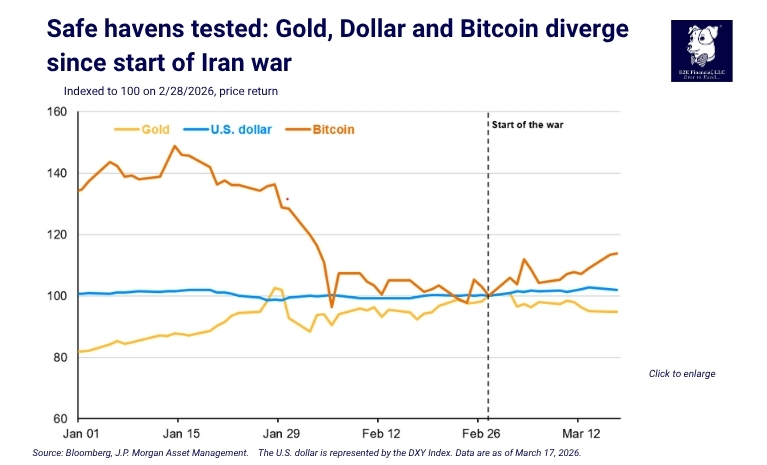
As investors grapple with the largest disruption to global energy markets on record, many have met elevated stagflation concerns with a renewed interest in “safe haven” assets – assets like the U.S. dollar, gold and Bitcoin that have typically acted as hedges to geopolitical uncertainty.
As a result, it is worth understanding how “safe” these “safe havens” have actually been:
The U.S. dollar has surged, clawing back some of its recent losses. It is possible to argue that the dollar’s rally is a “fear trade” rather than a fundamental one. However, U.S. energy independence suggests that the threat of stagflation is disproportionately sharper overseas. If interest rate differentials do not narrow as much as expected because foreign economic outlooks deteriorate, the dollar may not resume its aggressive downward slide.
Despite being considered the quintessential hedge against geopolitical turmoil, gold only initially rallied before ultimately pulling back. This modest sell-off is likely linked to the rise in global yields. Gold pays no coupon, and as yields rise, the opportunity cost of holding the metal increases. The longer-term structural case for a small gold allocation remains intact – dollar diversification, inflation protection and geopolitical hedging – but in the near term, gold is navigating competing forces that make its path forward choppier than the headline thesis implies.
After months of sustained downward pressure, Bitcoin appears to have found a floor, rallying over 10% since February 28. However, the durability of this rally is questionable: Bitcoin’s instantaneous liquidity is appealing for investors looking to raise cash on demand, but its historic positive correlation with stocks – selling off in 2022, rallying in the subsequent two years – makes it an ineffective diversifier. Moreover, Bitcoin’s viability as a true currency has been challenged since 2025’s GENIUS Act established a clear regulatory framework for stablecoins, and its lack of physical application puts it at a disadvantage to commodities.
For investors, there is a signal through the noise: “safe haven” markets are moving, not so much on geopolitics per se but on what elevated oil prices might mean for global growth, inflation and interest rates. The answer to that question remains elusive and uncertainty is still elevated as the conflict rages on. As a result, staying diversified and resisting the urge to make large tactical bets remain the most prudent position.”
We believe a well-diversified portfolio , patience, and an experienced expert are the keys to good long-term planning. Time for you to get your second opinion? Set up your free, initial consultation.
To read the full insights from J.P.Morgan click here.
And as always, your weekly market update is here.