Subscribe To Our Newsletter


Could U.S. GDP growth hit 5% this year?

Feb, 2026 | Blog

The resilience of the U.S. is amazing. Despite all the turmoil in the world, the U.S. economy somehow manages to look past it, power through it, and come out stronger on the other side. Here’s what Capital Group economist Jared Franz has to say:

“There is a lively debate among economists these days over whether U.S. economic growth could accelerate to 5% this year. That’s a number we haven’t seen on a sustained, multiyear basis since the 1960s and 1970s. Over the last two decades, U.S. gross domestic product (GDP) growth has generally been less than half that amount — averaging roughly 2.1%.

What needs to happen to return to the days of 5% growth? A lot. But based on my analysis, it is within the realm of possibility. And we really aren’t that far off, given that the most recent GDP print (3Q 2025) came in last week at 4.4% annualized.

1. Don’t discount election year politics
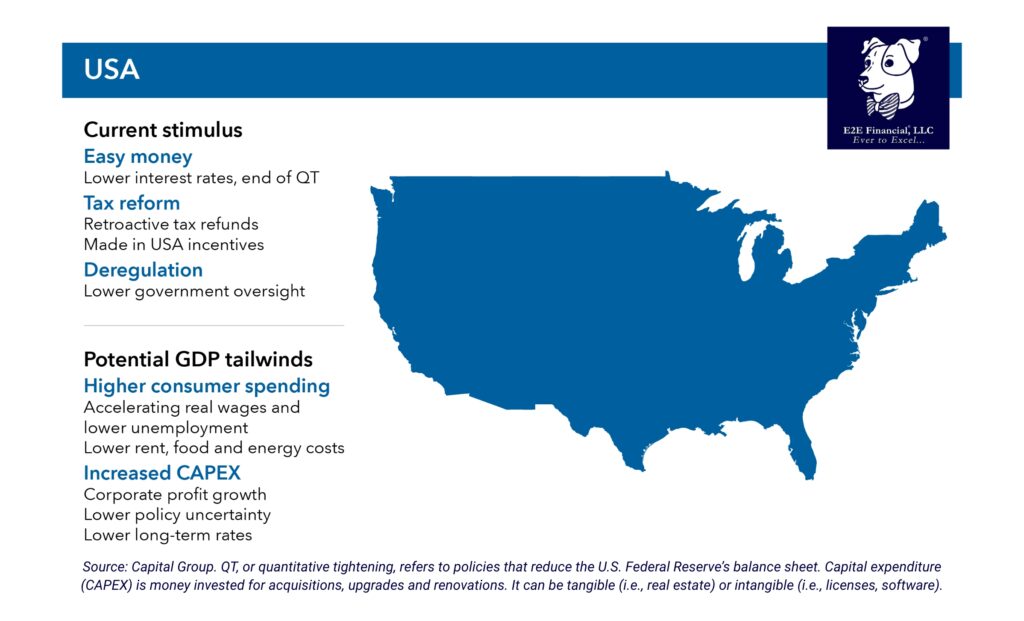
The first consideration is that 2026 is an election year. The U.S. midterm elections are just 10 months away, and President Trump has made it clear he wants to run the economy hot as we head toward November. That means bringing interest rates down, wages up, boosting the labor market, and using government stimulus measures to put money directly in the hands of American consumers.

2. Stimulus measures should boost consumption
Numerous government stimulus measures are already in place — from tax cuts included in the One Big Beautiful Bill Act, to retroactive tax refunds, to massive tax breaks and subsidies for companies that agree to move their manufacturing operations to the United States. More recently, the president has championed the idea of “tariff dividends” for U.S. citizens under certain income thresholds, though such a move typically requires an act of Congress.

3. AI-powered productivity boost
Finally, we need to see a rebound on the industrial side of the U.S. economy, which has been stagnant for the past three years. That’s an unusually long recession for U.S. industrial activity and, in my view, it isn’t likely to continue much longer. We are already seeing evidence of increasing inventory investments as the global economy, along with the U.S. economy, picks up speed.

While I think 5% GDP growth is possible this year, there are also many risks associated with such an optimistic forecast. In the stock market, we would call that “priced for perfection.” It leaves no room for disruption from trade disputes, geopolitical conflicts, labor market weakness, social unrest or market turbulence that could result from one or more of those events.”

Click here to read the full article from the Capital Group.

It’s important to feel confident about your future. Get a second look at your portfolio by scheduling a complimentary consultation with us.

And as always, your weekly market update is here.

Subscribe To Our Newsletter


Securities offered through LPL Financial, Member FINRA/SIPC. E2E Financial is another business name of Independent Advisor Alliance, LLC. All investment advice is offered through Independent Advisor Alliance LLC, a registered investment advisor. Independent Advisor Alliance is a separate entity from LPL Financial.

The information contained in this e-mail message is being transmitted to and is intended for the use of only the individual(s) to whom it is addressed. If the reader of this message is not the intended recipient, you are hereby advised that any dissemination, distribution or copying of this message is strictly prohibited. If you have received this message in error, please immediately delete.

This information is not intended to be a substitute for specific individualized tax or legal advice. We suggest that you discuss your specific situation with a qualified tax or legal advisor.

This material is for general information only and is not intended to provide specific advice or recommendations for any individual. Investing involves risk including the possible loss of principal.

The S&P 500 is a stock market index tracking the stock performance of 500 of the largest companies listed on stock exchanges in the United States. Indexes are unmanaged and cannot be invested in directly.

The Standard & Poor’s 500 Index (S&P500) is a capitalization-weighted index of 500 stocks designed to measure performance of the broad domestic economy through changes in the aggregate market value of 500 stocks representing all major industries.
The Bloomberg U.S. Aggregate Index represents the U.S. investment-grade fixed-rate bond market. This index is unmanaged, and its results include reinvested dividends and/or distributions but do not reflect the effect of sales charges, commissions, account fees, expenses or U.S. federal income taxes.

Bonds are subject to market and interest rate risk if sold prior to maturity. Bond values will decline as interest rates rise and bonds are subject to availability and change in price.

This material is for general information only and is not intended to provide specific advice or recommendations for any individual. There is no assurance that the views or strategies discussed are suitable for all investors or will yield positive outcomes. Investing involves risks including possible loss of principal. Any economic forecasts set forth may not develop as predicted and are subject to change.

There is no guarantee that a diversified portfolio will enhance overall returns or outperform a non-diversified portfolio. Diversification does not protect against market risk.

Market Index captures broad US equity coverage. The index includes 3,204 constituents across large, mid, small and micro capitalizations, about 99% of the US equity universe. Indexes are unmanaged and cannot be invested in directly.
International investing involves special risks such as currency fluctuation and political instability and may not be suitable for all investors. These risks are often heightened for investments in emerging markets.

Don’t miss the next one. Subscribe for early access.

ARE YOU READY TO TAKE YOUR PRACTICE TO THE NEXT LEVEL?